Kiri
| Dokumendiregister | Majandus- ja Kommunikatsiooniministeerium |
| Viit | 6-2/4036-1 |
| Registreeritud | 28.11.2025 |
| Sünkroonitud | 01.12.2025 |
| Liik | Sissetulev kiri |
| Funktsioon | 6 Rahvusvahelise koostöö korraldamine |
| Sari | 6-2 Rahvusvahelise koostöö korraldamise kirjavahetus |
| Toimik | 6-2/2025 |
| Juurdepääsupiirang | Avalik |
| Adressaat | Steinbeisi Euroopa Keskus |
| Saabumis/saatmisviis | Steinbeisi Euroopa Keskus |
| Vastutaja | Silver Tammik (Majandus- ja Kommunikatsiooniministeerium, Kantsleri valdkond, Strateegia ja teenuste juhtimise valdkond, EL ja rahvusvahelise koostöö osakond) |
| Originaal | Ava uues aknas |
| Taotle dokumendi eemaldamist või parandamist |
Failid
Tähelepanu! Tegemist on välisvõrgust saabunud kirjaga. |
- Main Outcomes:
- The brief draws on insights from workshops in Central Macedonia (Greece), Northern Portugal (Portugal), and Baden-Württemberg (Germany), highlighting both strengths and persistent challenges in regional smart health ecosystems.
- Key barriers identified include funding gaps (especially for clinical trials and validation), regulatory hurdles, fragmented data infrastructures, and uneven networking opportunities.
-
The brief provides recommendations for policymakers at regional, national, and EU levels, including:
- Closing funding gaps for clinical validation and early-stage growth through targeted instruments and blended finance.
- Developing interoperable health data infrastructures aligned with the European Health Data Space (EHDS).
- Promoting investor education and incentivising long-term engagement.
- Strengthening networking, mentoring, and cross-sector collaboration.
- Enhancing visibility and internationalisation of regional ecosystems.
____________________________
Dr. Alena Bubeck
Project Manager @Steinbeis Europa Zentrum
| Coordinator of
SHIFT-HUB
Steinbeis Europa Zentrum
Leuschnerstr. 43
70176 Stuttgart
E-Mail: [email protected] Tel: +49 711 25 24 2016
www.steinbeis-europa.de
Enterprise Europe Network Baden-Württemberg
Ein Unternehmen im Steinbeis Verbund
Headquarters: Steinbeis-Stiftung für Wirtschaftsförderung
Adornostr. 8, 70599 Stuttgart
Tel: +49 711 18 39-5
Internet: www.steinbeis.de,
E-Mail: [email protected]
Vorstandsvorsitzender: Prof. Dr. Michael Auer
Stiftungsverzeichnis RP Stuttgart, AZ 14-0563

0 Funded by the European Union. Views and opinions expressed are however those of the author(s) only
and do not necessarily reflect those of the European Union or the European Health and Digital
Executive Agency (HADEA). Neither the European Union nor the granting authority can be held
responsible for them. Project: 101095720
Policy Brief| Bridging Gaps
for Smart Health
BRIDGING GAPS FOR SMART HEALTH:
STRENGTHENING REGIONAL
INNOVATION ECOSYSTEMS IN EUROPE
Policy Brief
Funded by the European Union. Views and opinions expressed are however those of the author(s)
only and do not necessarily reflect those of the European Union or the European Health and Digital
Executive Agency (HADEA). Neither the European Union nor the granting authority can be held
responsible for them. Project: 101095720
Authors: Dr. Alena Bubeck, Leonie Fath
Steinbeis Europa Zentrum
Published: 02 September 2025
1 Funded by the European Union. Views and opinions expressed are however those of the author(s) only
and do not necessarily reflect those of the European Union or the European Health and Digital
Executive Agency (HADEA). Neither the European Union nor the granting authority can be held
responsible for them. Project: 101095720
Policy Brief| Bridging Gaps
for Smart Health
DISCLAIMER Funded by the European Union. Views and opinions expressed are however those of the
author(s) only and do not necessarily reflect those of the European Union or the
European Health and Digital Executive Agency (HADEA). Neither the European Union nor
the granting authority can be held responsible for them.
2 Funded by the European Union. Views and opinions expressed are however those of the author(s) only
and do not necessarily reflect those of the European Union or the European Health and Digital
Executive Agency (HADEA). Neither the European Union nor the granting authority can be held
responsible for them. Project: 101095720
Policy Brief| Bridging Gaps
for Smart Health
Table of contents
1. Summary ........................................................................................................................................ 3
2. Context of the issue ...................................................................................................................... 5
3. Policy Recommendations ............................................................................................................. 6
4. Evidence and Analysis ................................................................................................................... 8
Central Macedonia (Greece) ................................................................................................... 8
Northern Portugal (Portugal) .................................................................................................. 8
Baden-Württemberg (Germany) ............................................................................................ 9
5. Sources ........................................................................................................................................... 9
6. Contact ............................................................................................................................................ 9
List of Figures
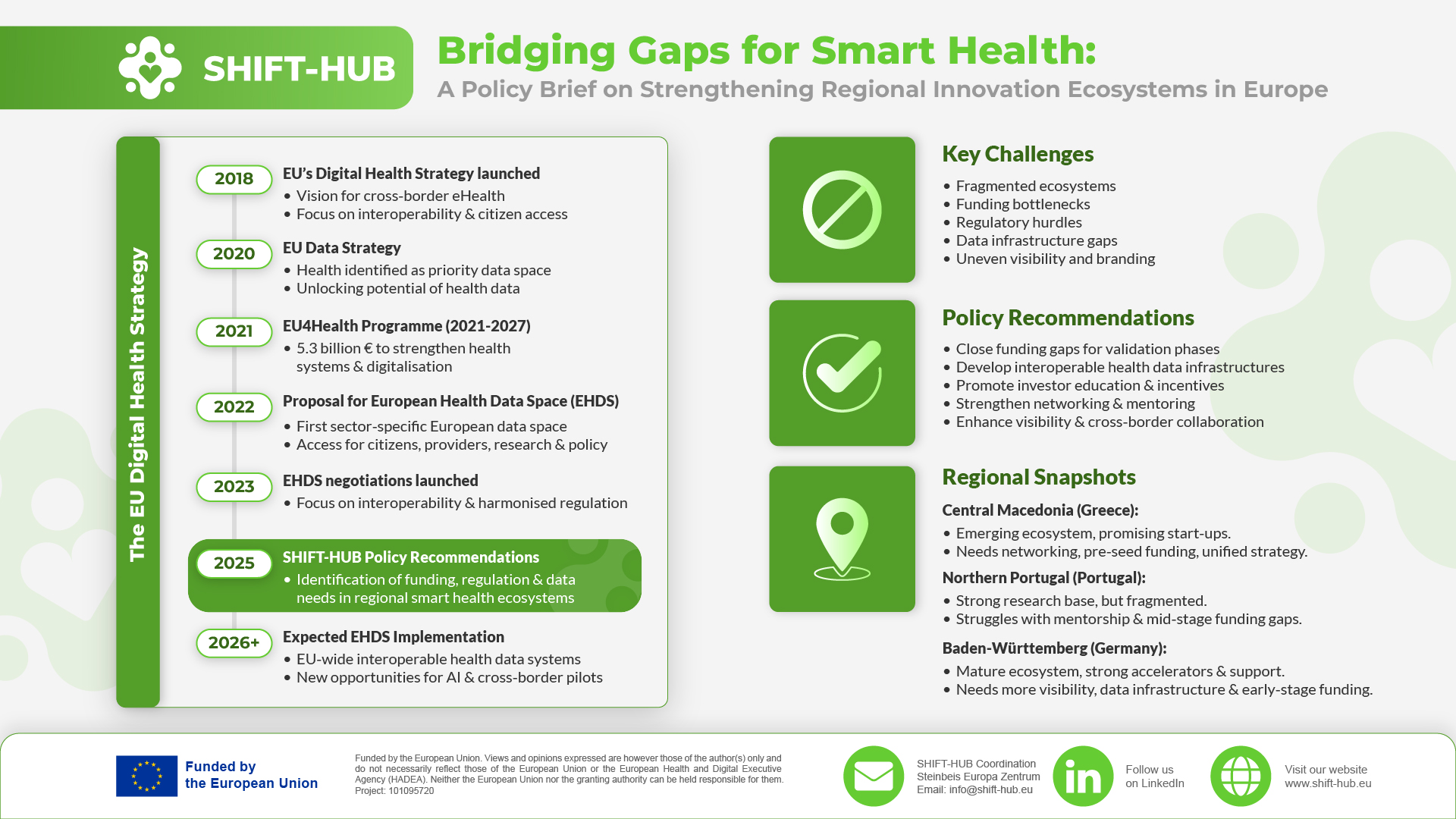
Figure 1. Infographic .............................................................................................................................. 4
Figure 2. Key challenges and barriers regional smart health ecosystems face. ............................ 5
3 Funded by the European Union. Views and opinions expressed are however those of the author(s) only
and do not necessarily reflect those of the European Union or the European Health and Digital
Executive Agency (HADEA). Neither the European Union nor the granting authority can be held
responsible for them. Project: 101095720
Policy Brief| Bridging Gaps
for Smart Health
1.Summary
Smart health ecosystems are vital to Europe’s digital health transition, driving innovation
that improves patient care, system efficiency, and competitiveness. Yet regional
ecosystems face common challenges, including funding gaps, regulatory hurdles, and
fragmented infrastructures.
This policy brief draws on insights from three workshops carried out by SHIFT-HUB, an EU-
funded project, in regional smart health ecosystems: Central Macedonia
(Greece)1,Northern Portugal (Portugal)2, and Baden-Württemberg (Germany)3, covering
three distinct and representative parts of Europe, namely Eastern, Western and Northern.
The policy brief compares regional strengths and needs, and provides evidence-based
recommendations to guide more targeted and effective policymaking at regional, national,
and EU level facilitating smart health innovations.
Highlights
➢ All three regions show promising smart health ecosystems, but yet face persistent
funding and regulatory hurdles.
➢ Funding gaps at various stages, especially for clinical trials and validation phases, limit
the ability of start-ups to scale successfully.
➢ Networking opportunities and cross-sector collaboration remain uneven, with calls
for stronger investor education and government facilitation.
➢ Data infrastructure and interoperability are missing links for innovation, particularly
in Baden-Württemberg and Central Macedonia.
➢ Internationalisation and visibility vary: Baden-Württemberg is well-connected but
under-promoted, while Northern Portugal and Central Macedonia seek stronger
integration into global ecosystems.
4 Funded by the European Union. Views and opinions expressed are however those of the author(s) only and do not
necessarily reflect those of the European Union or the European Health and Digital Executive Agency (HADEA). Neither the
European Union nor the granting authority can be held responsible for them. Project: 101095720
Policy Brief| Bridging Gaps
for Smart Health
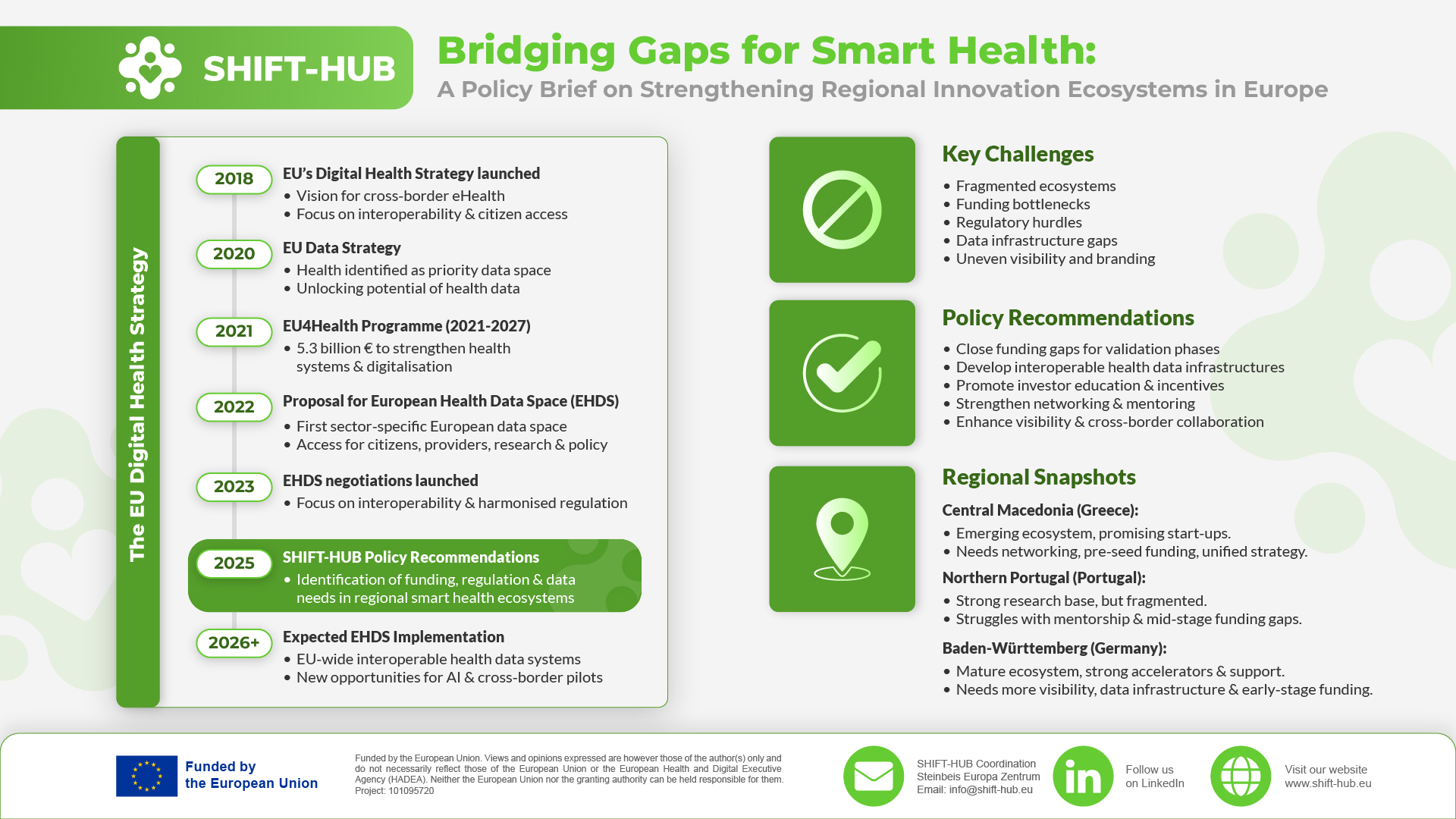
Figure 1. Infographic
5 Funded by the European Union. Views and opinions expressed are however those of the author(s) only
and do not necessarily reflect those of the European Union or the European Health and Digital
Executive Agency (HADEA). Neither the European Union nor the granting authority can be held
responsible for them. Project: 101095720
Policy Brief| Bridging Gaps
for Smart Health
2.Context of the issue
Smart health ecosystems represent a crucial building block in Europe’s ambition to
modernise healthcare, strengthen resilience, and foster sustainable growth. They
encompass digital health solutions, connected medical devices, artificial intelligence (AI) in
diagnostics and treatment, data-driven research, and patient-centric services. These
innovations can transform healthcare delivery by improving accessibility, efficiency, and
personalisation of care while simultaneously stimulating Europe’s competitiveness in
health technologies.
The European Union has made digital health transformation a central policy priority. The
EU’s Digital Health Strategy4 and the planned European Health Data Space (EHDS)5 aim to
unlock the value of health data, enable secure cross-border data flows, and empower
citizens with greater control over their health information. The EHDS
particularly will provide the regulatory and infrastructural framework
to foster interoperability of health data, creating new opportunities for
AI-driven applications and evidence-based healthcare policy.
Smart health ecosystems at regional level are key to realising these
ambitions, yet they face structural barriers. These barriers represent
key challenges that have been identified based on a workshop series
carried out within the scope of SHIFT-HUB, an project funded by the European Union, in
three regional European smart health ecosystems:
Figure 2. Key challenges and barriers regional smart health ecosystems face.
At the same time, these challenges open up opportunities for European alignment. By
strengthening regional ecosystems and connecting them more effectively across borders,
the EU can accelerate the translation of research into market-ready solutions, enhance
citizen trust in digital health, and ensure that European innovators can compete globally.
6 Funded by the European Union. Views and opinions expressed are however those of the author(s) only
and do not necessarily reflect those of the European Union or the European Health and Digital
Executive Agency (HADEA). Neither the European Union nor the granting authority can be held
responsible for them. Project: 101095720
Policy Brief| Bridging Gaps
for Smart Health
This policy brief contributes to the broader EU health and digital agenda by providing
evidence from three regional workshops (Central Macedonia1, Northern Portugal2, and
Baden-Württemberg3), identifying gaps, and offering recommendations on how to design
more targeted, needs-oriented policies that enable smart health ecosystems to thrive.
3. Policy Recommendations
Based on the insights gathered from the three SHIFT-HUB regional workshops in Central
Macedonia1, Northern Portugal2, and Baden-Württemberg3, the following recommendations
aim to address the identified challenges and support the development of stronger, more
interconnected smart health ecosystems across Europe. Structured around key objectives and
actions, they address the most pressing barriers—funding gaps, regulatory hurdles, data
infrastructure, networking, and visibility—while creating feasible, evidence-based pathways for
policymakers and stakeholders.
1. Objective: Close the funding gap for clinical validation and early-stage growth
Action: Establish targeted EU and regional instruments to finance critical validation
stages (clinical trials, regulatory approval, and market pilots). Use blended finance
combining grants with equity schemes to de-risk private investment.
Evidence: All three regions reported severe funding shortages, especially in early
validation and clinical trials. In Northern Portugal, start-ups highlighted the difficulty of
financing clinical trials, while Baden-Württemberg stakeholders identified the “vicious
cycle” between funding and regulatory compliance.
Impact: Greater access to validation funding will accelerate time-to-market for health
innovations, strengthen Europe’s competitiveness, and improve patient access to
digital health solutions.
Ethical dimension: Enables smaller start-ups and university spin-offs to bring patient-
oriented solutions to market, increasing equity of access to innovation.
2. Objective: Develop interoperable health data infrastructures
Action: Support the creation of regional and cross-border health data platforms
aligned with the European Health Data Space (EHDS), including clear guidelines for
SMEs and start-ups on secure access to anonymised datasets.
Evidence: Both Baden-Württemberg and Central Macedonia highlighted missing or
fragmented data infrastructures as a barrier to AI-driven solutions.
Impact: Interoperable infrastructures will facilitate cross-border research and enhance
Europe’s capacity to deliver personalised healthcare.
Ethical dimension: Governance frameworks must ensure GDPR compliance,
transparency, and trust to guarantee fair and safe use of health data.
7 Funded by the European Union. Views and opinions expressed are however those of the author(s) only
and do not necessarily reflect those of the European Union or the European Health and Digital
Executive Agency (HADEA). Neither the European Union nor the granting authority can be held
responsible for them. Project: 101095720
Policy Brief| Bridging Gaps
for Smart Health
3. Objective: Promote investor education and incentivise long-term engagement
Action: Develop EU-supported training programmes and risk-assessment tools for
investors in the health sector. Complement these with tax incentives or co-investment
schemes to stimulate private capital.
Evidence: Central Macedonia stakeholders stressed the lack of informed pre-seed
investors, while Northern Portugal pointed to over-reliance on grants.
Impact: Improved investor literacy and incentives will diversify financing, reduce
reliance on public funds, and strengthen sustainability.
Ethical dimension: Reduces information asymmetries and broadens access to capital
for innovators across regions.
4. Objective: Strengthen networking, mentoring, and cross-sector collaboration
Action: Create structured mentoring schemes and pan-European networks linking
researchers, start-ups, hospitals, and investors. Expand accelerator models, such as
LinkHealth@BW, into cross-regional clusters.
Evidence: All regions identified weak networking as a barrier, especially Central
Macedonia, where stakeholders called for more government-facilitated matchmaking.
Impact: A stronger collaborative culture will accelerate knowledge transfer, improve
alignment between research and market needs, and reduce duplication.
Ethical dimension: Ensures inclusive ecosystems where emerging regions gain access
to networks often concentrated in metropolitan hubs.
5. Objective: Enhance visibility and internationalisation of regional ecosystems
Action: Support regional branding strategies and EU-level campaigns showcasing
success stories. Create dedicated programmes for cross-border collaboration with
international ecosystems.
Evidence: Baden-Württemberg was recognised as strong but under-promoted;
Northern Portugal emphasised the need for internationalisation to retain
entrepreneurs; Central Macedonia called for a unified Greek ecosystem to reach
“critical mass.”
Impact: Greater visibility will attract investment, talent, and partnerships, embedding
regional ecosystems in Europe’s and the global innovation landscape.
Ethical dimension: Promotes a more balanced European innovation landscape,
reducing inequalities between high-profile and less visible regions.
8 Funded by the European Union. Views and opinions expressed are however those of the author(s) only
and do not necessarily reflect those of the European Union or the European Health and Digital
Executive Agency (HADEA). Neither the European Union nor the granting authority can be held
responsible for them. Project: 101095720
Policy Brief| Bridging Gaps
for Smart Health
4.Evidence and Analysis
The following section summarises the most relevant evidence gathered through the three
regional SHIFT-HUB Entrepreneurial Discovery workshops in Central Macedonia1, Northern
Portugal2, and Baden-Württemberg3. It presents key
findings from stakeholder discussions, expert insights,
and concrete examples that directly support the
proposed policy recommendations highlighting common
challenges and region-specific dynamics. The
methodology was based on a moderated, structured
panel discussion approach covering the three topics
(1) challenges/barriers/needs, (2) opportunities and
(3) comparison to other ecosystems. Answers and
discussions between regions were compared,
conclusions and recommendations formulated and revised by the panellists. For each
panel discussion, the panellists featured representatives of regional stakeholders across
the smart health ecosystem – including University/Research representatives supporting
Innovation or Technology Transfer, regional initiatives and Innovation Hubs, Venture
Capital organisations, Innovators and Entrepreneurs (Start-Ups, Solution Providers,
Technology Developers), regional Policymakers - enabling a comparative understanding of
barriers and enablers across different European contexts. Limitations remain, as the
workshops provide qualitative perspectives rather than comprehensive data, yet they offer
a robust and balanced reflection of ecosystem needs and opportunities.
Central Macedonia (Greece)1
Central Macedonia’s smart health ecosystem is in a maturing
phase, centred around Thessaloniki’s innovation zone and
the Aristotle University of Thessaloniki. Key challenges
include limited networking opportunities, lack of pre-seed
funding, weak government support, and insufficient critical
mass. Stakeholders called for a unified national ecosystem
and stronger European integration to enhance visibility and
investment attractiveness.
Northern Portugal (Portugal)2
Northern Portugal’s ecosystem is dynamic but still evolving. While strong in
research and early innovation, it struggles with gaps between early-stage and
late-stage funding, regulatory burdens, insufficient mentorship structures,
and actors operating in isolation. The ecosystem relies heavily on grants,
leading to sustainability challenges, and many entrepreneurs relocate abroad
due to lack of support. Internationalisation and reduction of fragmentation is
seen as crucial for attracting investment and building market-ready solutions.
9 Funded by the European Union. Views and opinions expressed are however those of the author(s) only
and do not necessarily reflect those of the European Union or the European Health and Digital
Executive Agency (HADEA). Neither the European Union nor the granting authority can be held
responsible for them. Project: 101095720
Policy Brief| Bridging Gaps
for Smart Health
Baden-Württemberg (Germany)3
Baden-Württemberg has a well-developed life sciences and smart health
ecosystem, with accelerators such as 4C, arise, and Life Science Accelerator
BW. The region benefits from strong networks and political support
facilitated by the well-connected state agency BIOPRO, but faces regulatory
complexity, early-stage funding gaps, and insufficient visibility. Also, data
infrastructure limitations hinder the scaling of AI-driven solutions.
Across all three regions, common issues include funding gaps in validation phases,
regulatory hurdles, and the need for better networking and collaboration structures.
Differences lie in maturity: Baden-Württemberg is well-established but under-promoted,
Portugal is research-strong but fragmented, and Central Macedonia is still building
foundational ecosystem structures.
5. Sources
1 Report SHIFT-HUB Entrepreneurial Discovery Workshop, Thessaloniki (Greece), 2024:
Exploring Central Macedonia’s Opportunities for Smart Health
2 Report SHIFT-HUB Entrepreneurial Discovery Workshop, Porto (Portugal), 2024: Exploring
Northern Portugal’s Opportunities for Smart Health
3 Report SHIFT-HUB Entrepreneurial Discovery Workshop, Stuttgart (Germany), 2025:
Exploring Baden-Württemberg’s Opportunities for Smart Health
4 Commission Communication 2018 (Year) 233: "COMMUNICATION FROM THE
COMMISSIONTO THE EUROPEAN PARLIAMENT, THE COUNCIL, THE EUROPEAN ECONOMIC
AND SOCIAL COMMITTEE AND THE COMMITTEE OF THE REGIONS on enabling the digital
transformation of health and care in the Digital Single Market; empowering citizens and
building a healthier society ". Document 52018DC0233
5 Commission Communication 2022 (Year) 196/2: “Communication from the Commission - A
European Health Data Space: harnessing the power of health data for people, patients and
innovation". Document 52022DC0196
6.Contact
SHIFT-HUB Coordination:
Steinbeis Europa Zentrum (Steinbeis 2i GmbH)
Email: [email protected]
Website: https://shift-hub.eu/
10 Funded by the European Union. Views and opinions expressed are however those of the author(s) only
and do not necessarily reflect those of the European Union or the European Health and Digital
Executive Agency (HADEA). Neither the European Union nor the granting authority can be held
responsible for them. Project: 101095720
Policy Brief| Bridging Gaps
for Smart Health
POLICY BRIEF |
BRIDGING GAPS FOR SMART HEALTH:
STRENGTHENING REGIONAL
INNOVATION ECOSYSTEMS IN EUROPE
POLICY BRIEF |
BRIDGING GAPS FOR SMART HEALTH:
STRENGTHENING REGIONAL
INNOVATION ECOSYSTEMS IN EUROPE
Funded by the Europ an U ion. View and opinions expressed are however those of the author(s)
only and do not necessarily reflect those of the European U ion or the European Health and Digital
Exe utive Agency (HADEA). Neither the Eur pean Union nor t e granting authority can be held
responsible for them. Project: 101095720
Visit our website www.shift-hub.eu
Follow us on LinkedIn See more

0 Funded by the European Union. Views and opinions expressed are however those of the author(s) only
and do not necessarily reflect those of the European Union or the European Health and Digital
Executive Agency (HADEA). Neither the European Union nor the granting authority can be held
responsible for them. Project: 101095720
Policy Brief| Bridging Gaps
for Smart Health
BRIDGING GAPS FOR SMART HEALTH:
STRENGTHENING REGIONAL
INNOVATION ECOSYSTEMS IN EUROPE
Policy Brief
Funded by the European Union. Views and opinions expressed are however those of the author(s)
only and do not necessarily reflect those of the European Union or the European Health and Digital
Executive Agency (HADEA). Neither the European Union nor the granting authority can be held
responsible for them. Project: 101095720
Authors: Dr. Alena Bubeck, Leonie Fath
Steinbeis Europa Zentrum
Published: 02 September 2025
1 Funded by the European Union. Views and opinions expressed are however those of the author(s) only
and do not necessarily reflect those of the European Union or the European Health and Digital
Executive Agency (HADEA). Neither the European Union nor the granting authority can be held
responsible for them. Project: 101095720
Policy Brief| Bridging Gaps
for Smart Health
DISCLAIMER Funded by the European Union. Views and opinions expressed are however those of the
author(s) only and do not necessarily reflect those of the European Union or the
European Health and Digital Executive Agency (HADEA). Neither the European Union nor
the granting authority can be held responsible for them.
2 Funded by the European Union. Views and opinions expressed are however those of the author(s) only
and do not necessarily reflect those of the European Union or the European Health and Digital
Executive Agency (HADEA). Neither the European Union nor the granting authority can be held
responsible for them. Project: 101095720
Policy Brief| Bridging Gaps
for Smart Health
Table of contents
1. Summary ........................................................................................................................................ 3
2. Context of the issue ...................................................................................................................... 5
3. Policy Recommendations ............................................................................................................. 6
4. Evidence and Analysis ................................................................................................................... 8
Central Macedonia (Greece) ................................................................................................... 8
Northern Portugal (Portugal) .................................................................................................. 8
Baden-Württemberg (Germany) ............................................................................................ 9
5. Sources ........................................................................................................................................... 9
6. Contact ............................................................................................................................................ 9
List of Figures
Figure 1. Infographic .............................................................................................................................. 4
Figure 2. Key challenges and barriers regional smart health ecosystems face. ............................ 5
3 Funded by the European Union. Views and opinions expressed are however those of the author(s) only
and do not necessarily reflect those of the European Union or the European Health and Digital
Executive Agency (HADEA). Neither the European Union nor the granting authority can be held
responsible for them. Project: 101095720
Policy Brief| Bridging Gaps
for Smart Health
1.Summary
Smart health ecosystems are vital to Europe’s digital health transition, driving innovation
that improves patient care, system efficiency, and competitiveness. Yet regional
ecosystems face common challenges, including funding gaps, regulatory hurdles, and
fragmented infrastructures.
This policy brief draws on insights from three workshops carried out by SHIFT-HUB, an EU-
funded project, in regional smart health ecosystems: Central Macedonia
(Greece)1,Northern Portugal (Portugal)2, and Baden-Württemberg (Germany)3, covering
three distinct and representative parts of Europe, namely Eastern, Western and Northern.
The policy brief compares regional strengths and needs, and provides evidence-based
recommendations to guide more targeted and effective policymaking at regional, national,
and EU level facilitating smart health innovations.
Highlights
➢ All three regions show promising smart health ecosystems, but yet face persistent
funding and regulatory hurdles.
➢ Funding gaps at various stages, especially for clinical trials and validation phases, limit
the ability of start-ups to scale successfully.
➢ Networking opportunities and cross-sector collaboration remain uneven, with calls
for stronger investor education and government facilitation.
➢ Data infrastructure and interoperability are missing links for innovation, particularly
in Baden-Württemberg and Central Macedonia.
➢ Internationalisation and visibility vary: Baden-Württemberg is well-connected but
under-promoted, while Northern Portugal and Central Macedonia seek stronger
integration into global ecosystems.
4 Funded by the European Union. Views and opinions expressed are however those of the author(s) only and do not
necessarily reflect those of the European Union or the European Health and Digital Executive Agency (HADEA). Neither the
European Union nor the granting authority can be held responsible for them. Project: 101095720
Policy Brief| Bridging Gaps
for Smart Health
Figure 1. Infographic
5 Funded by the European Union. Views and opinions expressed are however those of the author(s) only
and do not necessarily reflect those of the European Union or the European Health and Digital
Executive Agency (HADEA). Neither the European Union nor the granting authority can be held
responsible for them. Project: 101095720
Policy Brief| Bridging Gaps
for Smart Health
2.Context of the issue
Smart health ecosystems represent a crucial building block in Europe’s ambition to
modernise healthcare, strengthen resilience, and foster sustainable growth. They
encompass digital health solutions, connected medical devices, artificial intelligence (AI) in
diagnostics and treatment, data-driven research, and patient-centric services. These
innovations can transform healthcare delivery by improving accessibility, efficiency, and
personalisation of care while simultaneously stimulating Europe’s competitiveness in
health technologies.
The European Union has made digital health transformation a central policy priority. The
EU’s Digital Health Strategy4 and the planned European Health Data Space (EHDS)5 aim to
unlock the value of health data, enable secure cross-border data flows, and empower
citizens with greater control over their health information. The EHDS
particularly will provide the regulatory and infrastructural framework
to foster interoperability of health data, creating new opportunities for
AI-driven applications and evidence-based healthcare policy.
Smart health ecosystems at regional level are key to realising these
ambitions, yet they face structural barriers. These barriers represent
key challenges that have been identified based on a workshop series
carried out within the scope of SHIFT-HUB, an project funded by the European Union, in
three regional European smart health ecosystems:
Figure 2. Key challenges and barriers regional smart health ecosystems face.
At the same time, these challenges open up opportunities for European alignment. By
strengthening regional ecosystems and connecting them more effectively across borders,
the EU can accelerate the translation of research into market-ready solutions, enhance
citizen trust in digital health, and ensure that European innovators can compete globally.
6 Funded by the European Union. Views and opinions expressed are however those of the author(s) only
and do not necessarily reflect those of the European Union or the European Health and Digital
Executive Agency (HADEA). Neither the European Union nor the granting authority can be held
responsible for them. Project: 101095720
Policy Brief| Bridging Gaps
for Smart Health
This policy brief contributes to the broader EU health and digital agenda by providing
evidence from three regional workshops (Central Macedonia1, Northern Portugal2, and
Baden-Württemberg3), identifying gaps, and offering recommendations on how to design
more targeted, needs-oriented policies that enable smart health ecosystems to thrive.
3. Policy Recommendations
Based on the insights gathered from the three SHIFT-HUB regional workshops in Central
Macedonia1, Northern Portugal2, and Baden-Württemberg3, the following recommendations
aim to address the identified challenges and support the development of stronger, more
interconnected smart health ecosystems across Europe. Structured around key objectives and
actions, they address the most pressing barriers—funding gaps, regulatory hurdles, data
infrastructure, networking, and visibility—while creating feasible, evidence-based pathways for
policymakers and stakeholders.
1. Objective: Close the funding gap for clinical validation and early-stage growth
Action: Establish targeted EU and regional instruments to finance critical validation
stages (clinical trials, regulatory approval, and market pilots). Use blended finance
combining grants with equity schemes to de-risk private investment.
Evidence: All three regions reported severe funding shortages, especially in early
validation and clinical trials. In Northern Portugal, start-ups highlighted the difficulty of
financing clinical trials, while Baden-Württemberg stakeholders identified the “vicious
cycle” between funding and regulatory compliance.
Impact: Greater access to validation funding will accelerate time-to-market for health
innovations, strengthen Europe’s competitiveness, and improve patient access to
digital health solutions.
Ethical dimension: Enables smaller start-ups and university spin-offs to bring patient-
oriented solutions to market, increasing equity of access to innovation.
2. Objective: Develop interoperable health data infrastructures
Action: Support the creation of regional and cross-border health data platforms
aligned with the European Health Data Space (EHDS), including clear guidelines for
SMEs and start-ups on secure access to anonymised datasets.
Evidence: Both Baden-Württemberg and Central Macedonia highlighted missing or
fragmented data infrastructures as a barrier to AI-driven solutions.
Impact: Interoperable infrastructures will facilitate cross-border research and enhance
Europe’s capacity to deliver personalised healthcare.
Ethical dimension: Governance frameworks must ensure GDPR compliance,
transparency, and trust to guarantee fair and safe use of health data.
7 Funded by the European Union. Views and opinions expressed are however those of the author(s) only
and do not necessarily reflect those of the European Union or the European Health and Digital
Executive Agency (HADEA). Neither the European Union nor the granting authority can be held
responsible for them. Project: 101095720
Policy Brief| Bridging Gaps
for Smart Health
3. Objective: Promote investor education and incentivise long-term engagement
Action: Develop EU-supported training programmes and risk-assessment tools for
investors in the health sector. Complement these with tax incentives or co-investment
schemes to stimulate private capital.
Evidence: Central Macedonia stakeholders stressed the lack of informed pre-seed
investors, while Northern Portugal pointed to over-reliance on grants.
Impact: Improved investor literacy and incentives will diversify financing, reduce
reliance on public funds, and strengthen sustainability.
Ethical dimension: Reduces information asymmetries and broadens access to capital
for innovators across regions.
4. Objective: Strengthen networking, mentoring, and cross-sector collaboration
Action: Create structured mentoring schemes and pan-European networks linking
researchers, start-ups, hospitals, and investors. Expand accelerator models, such as
LinkHealth@BW, into cross-regional clusters.
Evidence: All regions identified weak networking as a barrier, especially Central
Macedonia, where stakeholders called for more government-facilitated matchmaking.
Impact: A stronger collaborative culture will accelerate knowledge transfer, improve
alignment between research and market needs, and reduce duplication.
Ethical dimension: Ensures inclusive ecosystems where emerging regions gain access
to networks often concentrated in metropolitan hubs.
5. Objective: Enhance visibility and internationalisation of regional ecosystems
Action: Support regional branding strategies and EU-level campaigns showcasing
success stories. Create dedicated programmes for cross-border collaboration with
international ecosystems.
Evidence: Baden-Württemberg was recognised as strong but under-promoted;
Northern Portugal emphasised the need for internationalisation to retain
entrepreneurs; Central Macedonia called for a unified Greek ecosystem to reach
“critical mass.”
Impact: Greater visibility will attract investment, talent, and partnerships, embedding
regional ecosystems in Europe’s and the global innovation landscape.
Ethical dimension: Promotes a more balanced European innovation landscape,
reducing inequalities between high-profile and less visible regions.
8 Funded by the European Union. Views and opinions expressed are however those of the author(s) only
and do not necessarily reflect those of the European Union or the European Health and Digital
Executive Agency (HADEA). Neither the European Union nor the granting authority can be held
responsible for them. Project: 101095720
Policy Brief| Bridging Gaps
for Smart Health
4.Evidence and Analysis
The following section summarises the most relevant evidence gathered through the three
regional SHIFT-HUB Entrepreneurial Discovery workshops in Central Macedonia1, Northern
Portugal2, and Baden-Württemberg3. It presents key
findings from stakeholder discussions, expert insights,
and concrete examples that directly support the
proposed policy recommendations highlighting common
challenges and region-specific dynamics. The
methodology was based on a moderated, structured
panel discussion approach covering the three topics
(1) challenges/barriers/needs, (2) opportunities and
(3) comparison to other ecosystems. Answers and
discussions between regions were compared,
conclusions and recommendations formulated and revised by the panellists. For each
panel discussion, the panellists featured representatives of regional stakeholders across
the smart health ecosystem – including University/Research representatives supporting
Innovation or Technology Transfer, regional initiatives and Innovation Hubs, Venture
Capital organisations, Innovators and Entrepreneurs (Start-Ups, Solution Providers,
Technology Developers), regional Policymakers - enabling a comparative understanding of
barriers and enablers across different European contexts. Limitations remain, as the
workshops provide qualitative perspectives rather than comprehensive data, yet they offer
a robust and balanced reflection of ecosystem needs and opportunities.
Central Macedonia (Greece)1
Central Macedonia’s smart health ecosystem is in a maturing
phase, centred around Thessaloniki’s innovation zone and
the Aristotle University of Thessaloniki. Key challenges
include limited networking opportunities, lack of pre-seed
funding, weak government support, and insufficient critical
mass. Stakeholders called for a unified national ecosystem
and stronger European integration to enhance visibility and
investment attractiveness.
Northern Portugal (Portugal)2
Northern Portugal’s ecosystem is dynamic but still evolving. While strong in
research and early innovation, it struggles with gaps between early-stage and
late-stage funding, regulatory burdens, insufficient mentorship structures,
and actors operating in isolation. The ecosystem relies heavily on grants,
leading to sustainability challenges, and many entrepreneurs relocate abroad
due to lack of support. Internationalisation and reduction of fragmentation is
seen as crucial for attracting investment and building market-ready solutions.
9 Funded by the European Union. Views and opinions expressed are however those of the author(s) only
and do not necessarily reflect those of the European Union or the European Health and Digital
Executive Agency (HADEA). Neither the European Union nor the granting authority can be held
responsible for them. Project: 101095720
Policy Brief| Bridging Gaps
for Smart Health
Baden-Württemberg (Germany)3
Baden-Württemberg has a well-developed life sciences and smart health
ecosystem, with accelerators such as 4C, arise, and Life Science Accelerator
BW. The region benefits from strong networks and political support
facilitated by the well-connected state agency BIOPRO, but faces regulatory
complexity, early-stage funding gaps, and insufficient visibility. Also, data
infrastructure limitations hinder the scaling of AI-driven solutions.
Across all three regions, common issues include funding gaps in validation phases,
regulatory hurdles, and the need for better networking and collaboration structures.
Differences lie in maturity: Baden-Württemberg is well-established but under-promoted,
Portugal is research-strong but fragmented, and Central Macedonia is still building
foundational ecosystem structures.
5. Sources
1 Report SHIFT-HUB Entrepreneurial Discovery Workshop, Thessaloniki (Greece), 2024:
Exploring Central Macedonia’s Opportunities for Smart Health
2 Report SHIFT-HUB Entrepreneurial Discovery Workshop, Porto (Portugal), 2024: Exploring
Northern Portugal’s Opportunities for Smart Health
3 Report SHIFT-HUB Entrepreneurial Discovery Workshop, Stuttgart (Germany), 2025:
Exploring Baden-Württemberg’s Opportunities for Smart Health
4 Commission Communication 2018 (Year) 233: "COMMUNICATION FROM THE
COMMISSIONTO THE EUROPEAN PARLIAMENT, THE COUNCIL, THE EUROPEAN ECONOMIC
AND SOCIAL COMMITTEE AND THE COMMITTEE OF THE REGIONS on enabling the digital
transformation of health and care in the Digital Single Market; empowering citizens and
building a healthier society ". Document 52018DC0233
5 Commission Communication 2022 (Year) 196/2: “Communication from the Commission - A
European Health Data Space: harnessing the power of health data for people, patients and
innovation". Document 52022DC0196
6.Contact
SHIFT-HUB Coordination:
Steinbeis Europa Zentrum (Steinbeis 2i GmbH)
Email: [email protected]
Website: https://shift-hub.eu/
10 Funded by the European Union. Views and opinions expressed are however those of the author(s) only
and do not necessarily reflect those of the European Union or the European Health and Digital
Executive Agency (HADEA). Neither the European Union nor the granting authority can be held
responsible for them. Project: 101095720
Policy Brief| Bridging Gaps
for Smart Health
POLICY BRIEF |
BRIDGING GAPS FOR SMART HEALTH:
STRENGTHENING REGIONAL
INNOVATION ECOSYSTEMS IN EUROPE
POLICY BRIEF |
BRIDGING GAPS FOR SMART HEALTH:
STRENGTHENING REGIONAL
INNOVATION ECOSYSTEMS IN EUROPE
Funded by the Europ an U ion. View and opinions expressed are however those of the author(s)
only and do not necessarily reflect those of the European U ion or the European Health and Digital
Exe utive Agency (HADEA). Neither the Eur pean Union nor t e granting authority can be held
responsible for them. Project: 101095720
Visit our website www.shift-hub.eu
Follow us on LinkedIn See more